
Nail fungus treatment by laser in Berlin, gentle and without tablets
Nail fungus is stubborn: creams and lacquers do not penetrate the nail well, and tablets put a strain on the body. At Dr. Homssi's practice, we treat nail fungus with laser, without medication and usually in four to six sessions.
Medically reviewed by Dr. Univ.-PD Amro Homssi, Specialist in Orthopaedics and Trauma Surgery · Last updated: October 2026
- Consultation appointment usually within 24 h
- Without tablets
- Walking possible straight away
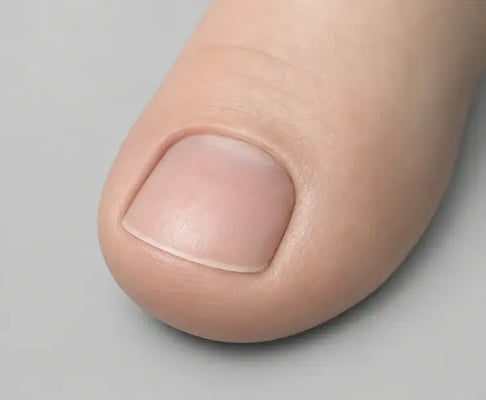 At a glance
Nail fungus (onychomycosis)
- Common fungal infection, usually of the toenails
- Typical signs: yellowish discolouration, thickening, brittle nail
- Contagious, for example in swimming pools and changing rooms
- Laser: usually 4 to 6 sessions, without tablets
- Success rate around 80%, up to 90% with a special nail lacquer
- 80 to 90%Laser success rate
- 4 to 6Sessions
- 0Tablets
- SpecialistOrthopaedics & Trauma Surgery
What is nail fungus?
Nail fungus, medically known as onychomycosis, is a fungal infection of the nail plate and nail bed. It is usually caused by filamentous fungi (dermatophytes), above all Trichophyton rubrum; in this case it is also called tinea unguium. Less often, yeasts or moulds are the cause. The toenails are most commonly affected, especially the big toe.
Nail fungus is common: according to IQWiG, around 3 to 12% of the population have nail fungus, and the risk rises markedly with age. Nail fungus usually does not clear up on its own.
| Medical term | Onychomycosis, tinea unguium (ICD-10: B35.1) |
|---|---|
| Cause | usually filamentous fungi (dermatophytes), less often yeasts or moulds |
| Frequency | around 3 to 12% of the population, considerably more common in older age |
| Most common site | toenails, especially the big toe |
| Typical signs | yellowish or whitish discolouration, thickened and brittle nail |
| Our treatment | laser, without tablets, usually 4 to 6 sessions |
More detail in our guide: Recognising nail fungus: pictures and symptoms (in German)
Types of nail fungus
Depending on where the fungus enters the nail, doctors distinguish between several types:
| Type | Typical appearance | What it means for treatment |
|---|---|---|
| Distal lateral subungual onychomycosis | most common type; starts at the front or side edge of the nail and spreads towards the nail root | in the early stages often nail lacquer; if more of the nail is affected, laser, tablets or a combination |
| White superficial onychomycosis | white, chalky patches on the nail surface | often responds well to local treatment |
| Proximal subungual onychomycosis | rare; starts at the nail root under the cuticle | should be assessed by a doctor, more common with a weakened immune system; lacquer alone is usually not enough |
| Total dystrophic onychomycosis | end stage: the whole nail is thickened, crumbling and deformed | remove the nail, then combine several treatments |
However, not every thick nail is caused by fungus: Thickened nails: causes and treatment (in German)
Causes and risk factors
Fungal spores are widespread. Whether they lead to nail fungus depends on how well the skin and nails are protected. These factors increase the risk:
- Athlete's foot: the most common cause; the fungus spreads from the skin to the nail. More on athlete's foot (in German)
- Diabetes and circulatory problems: the toes are less able to fight off fungi, and complications are more serious.
- Older age: nails grow more slowly, and minor injuries become more frequent.
- Sport and swimming pools: walking barefoot in pools, saunas and changing rooms, sweaty feet in sports shoes.
- Tight shoes: a warm, damp climate inside the shoe and pressure on the nails.
- Nail injuries: knocks, crush injuries or nails cut too short open the way for the fungus.
- Weakened immune system: for example due to medication that suppresses the immune system.
Is nail fungus contagious?
Yes, although it does not spread as easily as a cold. The fungus is transmitted via tiny flakes of skin and nail. On warm, damp floors in swimming pools, saunas, showers and changing rooms, the spores remain infectious for a long time. Within a family, it spreads via shared towels, bath mats, shoes and nail scissors.
Healthy, dry and intact skin is good at fighting off fungi. Softened skin, small cracks or untreated athlete's foot make infection easier. If several people in a household are affected, everyone should be treated at the same time; otherwise you will keep reinfecting each other.
What happens if nail fungus is not treated?
Nail fungus usually does not clear up on its own and slowly continues to spread. Possible consequences:
- Spreading: the fungus spreads to other nails and to the skin of the feet.
- Thickening: the nail becomes thick and hard and is difficult to cut.
- Pain in shoes: deformed nails press and can grow into the skin. Ingrown toenail
- The nail comes loose: it lifts off the nail bed or crumbles. Onycholysis: when the nail detaches (in German)
- Entry point for bacteria: bacteria can enter through cracked skin and cause erysipelas, for example. In people with diabetes, this can lead to a wound that heals poorly. Diabetic foot (in German)
The longer the fungus is present, the longer treatment takes. It is worth acting early.
How can I recognise nail fungus?
These signs suggest a fungal infection of the nail:
- Whitish, yellowish or brownish discolouration, often starting at the edge
- Thickened nail that is difficult to cut
- Brittle, crumbling or cracked nail
- The nail comes away from the nail bed
- Unpleasant smell
- Pain from pressure in shoes when the infection is advanced
What you can do yourself
If only a small part of one nail is affected, you can achieve a lot yourself with an over-the-counter nail lacquer from the pharmacy and good foot care. These measures also support any medical treatment:
- Trim and file affected parts of the nail: trim discoloured parts regularly and file the surface about once a week so that a nail lacquer works better.
- Your own file: use a separate file for affected nails and disinfect scissors after each use.
- Keep your feet dry: after showering, dry thoroughly between the toes as well.
- Wash socks at 60 °C: change your socks every day and wash socks and towels at 60 °C or higher.
- Treat athlete's foot as well: otherwise the nail fungus will come back.
- Your own towel: for your feet, not shared with others.
- Disinfect your shoes: with an antifungal spray from the pharmacy, air them well and alternate between pairs.
Do home remedies help against nail fungus?
Tea tree oil, vinegar or bicarbonate of soda are often recommended. There are hardly any good studies showing that they work. These remedies do not penetrate the nail sufficiently and can irritate the skin. Above all, the fungus continues to grow while you are trying them out. Home remedies for nail fungus: what they can do (in German)
When you should see a doctor
- if more than a small part of the nail, the nail root or several nails are affected
- if the nail becomes thick, painful or comes loose
- if no healthy nail has grown back after about three months of using nail lacquer
- early on if you have diabetes, circulatory problems or a weakened immune system
- if you are unsure whether it is nail fungus at all
Preventing nail fungus
Nail fungus often comes back, even after successful treatment. This is how you can reduce the risk:
- Wear pool shoes in swimming pools, saunas, changing rooms and hotels.
- Wear breathable shoes and let damp shoes dry thoroughly.
- Treat athlete's foot early, before it spreads to the nails.
- Cut nails straight across and not too short.
- Do not share towels, shoes or nail scissors.
- Check your feet regularly, every day if you have diabetes.
All treatments compared
Which treatment is right for you depends on how much of the nail is affected, how many nails are involved, whether the nail root is affected, and which pre-existing conditions you have and which medicines you take. What all treatments have in common: the discoloured nail does not become clear again, but has to grow out healthy.
Confirm the diagnosis first: not every yellow or thick nail is caused by fungus. Nail psoriasis, pressure damage from shoes or a detached nail often look similar. Before a treatment lasting several months, a fungal infection should therefore be confirmed from nail clippings, under the microscope, by culture or by PCR. Yellow toenails: when it is not nail fungus (in German)
| Treatment | Suitable for | Duration | Pros and cons |
|---|---|---|---|
| Nail lacquer (amorolfine, ciclopirox) | mild infection, less than about half of the nail, nail root not affected | for toenails often 9 to 12 months or longer | available without a prescription, hardly any side effects; penetrates thick nails poorly, requires a lot of perseverance |
| Nail-softening cream (urea, bifonazole) | thickened nails, as preparation or in addition to other treatment | softening about 1 to 2 weeks, then around 4 weeks of cream | removes affected parts without a procedure; daily dressing, often not enough on its own |
| Tablets (terbinafine, itraconazole) | extensive infection, several nails, nail root affected | usually about 3 months | work from the inside; prescription only, liver function tests, interactions possible, not during pregnancy |
| Laser treatment | mild to extensive infection, especially if tablets are not an option | usually 4 to 6 sessions | no medication or blood tests, walking straight afterwards; self-pay service, fewer large studies than for medication |
| Combination | severe infection, recurrence | depends on the methods used | the methods complement each other; more effort |
Nail lacquer
Amorolfine is usually applied once or twice a week, ciclopirox daily or every other day depending on the product, each time after filing the nail. It is important to continue until the nail has grown back completely healthy.
Nail-softening cream
An ointment containing high-dose urea and bifonazole softens the affected nail under a plaster so that the diseased parts can be removed. The nail bed is then treated with a cream for a few more weeks.
Tablets
Terbinafine is usually taken daily for about three months, itraconazole often in cycles. Possible side effects include stomach and bowel complaints, changes in taste and, rarely, liver damage, which is why liver function is monitored. Itraconazole in particular interacts with other medicines. The tablets are not suitable during pregnancy and breastfeeding.
Laser treatment
The laser energy penetrates the nail plate and damages the fungi without injuring the surrounding tissue. You do not need tablets or blood tests, and there are no interactions with medicines. The laser works best together with consistent care at home and, where appropriate, a nail lacquer. You can find all prices under Cost of laser treatment.
Combination
For severe infection or after a recurrence, a combination is often the most sensible approach, for example removing thickened parts of the nail, laser and a nail lacquer at home. We will discuss which combination is right for you after the examination.
Laser treatment of nail fungus
The affected nail is cleaned and disinfected. The doctor then guides the laser over the nail: the laser energy penetrates the nail plate and damages the fungi without injuring the surrounding tissue. This is repeated several times. Afterwards, you will receive advice on nail care and on avoiding reinfection.
- ✦
Without tablets
No strain from medication, no blood tests needed.
- ✚
Little pain
The treatment is well tolerated, and no anaesthetic is needed.
- ⏱
Back on your feet straight away
You can walk and go about your day immediately after the session.
- ◈
4 to 6 sessions
The sessions take place a few weeks apart.
Laser treatment and tablets compared
Tablets (oral antifungals)
- Taken over weeks to months
- Regular blood tests because of possible liver damage
- Strain on the body
- Interactions with other medicines
- Lengthy treatment
- Success rate of around 55%
Laser treatment
- Without medication
- No blood tests needed
- Walking possible straight away
- Little pain
- Usually 4 to 6 treatments
- Success rate around 80%, up to 90% with a special nail lacquer
How laser treatment of nail fungus works
The treatment takes place on an outpatient basis at our practice in Berlin-Prenzlauer Berg:
- Examination and fungal test: Dr. Homssi examines your nails and feet and confirms the diagnosis, with a fungal test if necessary. We also check whether athlete's foot needs to be treated at the same time.
- Preparing the nail: the affected nails are trimmed and thickened parts are removed so that the laser energy can reach the nail and nail bed effectively.
- Laser sessions: the laser is guided over the nail in several passes. An anaesthetic is usually not needed, and you can walk again straight afterwards. Usually 4 to 6 sessions are needed; we set the interval between them individually.
- Care at home: trimming and filing, hygiene, disinfected shoes and, if we recommend it, a nail lacquer support the treatment.
- Growing out: over several months, the healthy nail grows forward from the base of the nail. For toenails, it takes about 12 to 18 months for the nail to be completely renewed.
Good to know: the laser does not make the part that is already discoloured clear again. Whether the treatment is working can be seen from the healthy, clear nail growing out from the base of the nail.
How much does laser treatment for nail fungus cost?
The costs depend on whether one foot or both feet are treated and on the number of sessions:
| Area treated | Per session | For 4 sessions | For 6 sessions |
|---|---|---|---|
| 1 foot | €80.44 | €321.76 | €482.64 |
| Both feet | €122.40 | €489.60 | €734.40 |
We will discuss how many sessions you need after the examination.
Does health insurance pay? Statutory health insurance does not usually cover laser treatment of nail fungus; it is a self-pay service. Private health insurers reimburse it in part, depending on your policy. It is best to check with your insurer beforehand; you will receive an invoice from us in accordance with the German medical fee schedule (GOÄ).
Consultation at our practice is free of charge with health insurance. The video consultation costs €46.93 and is paid directly when booking. Book an appointment now · Directions to the practice
Special situations
Diabetes
People with diabetes get nail fungus more often, and for them it is riskier: if sensation in the feet is reduced, thickened nails can cause pressure sores without being noticed, and bacteria can enter the skin through small injuries. You should therefore have nail fungus treated early and should not trim thickened nails yourself with sharp tools. Laser treatment does not require any additional medication, which is often an advantage for people with diabetes. Nail fungus and diabetes: what to look out for (in German)
Children
Nail fungus is rare in children. Often, parents or siblings also have athlete's foot or nail fungus, and everyone affected should be treated at the same time. Children's nails are thinner and grow faster, so they often respond well to lacquers and creams. Tablets are only considered in exceptional cases. We will decide together with you after the examination whether laser treatment makes sense.
Pregnancy and breastfeeding
Tablets for nail fungus are not suitable during this time. Nail fungus is not an emergency, and treatment can often wait. If you do not want to wait, local treatment or laser treatment may be an option after consulting a doctor.
Older people and multiple medications
Nails grow more slowly with age, so treatment takes longer. People who take several medicines, for example for high blood pressure or to thin the blood, need to watch out for interactions if they take antifungal tablets. The laser avoids this problem because it does not involve any medication. If foot care is difficult, a podiatrist can help with trimming and filing.

Dr. Univ.-PD Amro Homssi, Specialist in Orthopaedics and Trauma Surgery in Berlin
My aim is to provide treatment that is tailored to your needs and reflects current medical knowledge. At our practice on Greifswalder Straße, we offer a range of orthopaedic and surgical services with modern equipment, both conservative and surgical.
We carry out minor operations, including laser treatment of ingrown toenails, as outpatient procedures at the practice. Larger procedures take place at the adjacent hospital.
- Specialist in Orthopaedics and Trauma Surgery, accident insurance consultant (D-Arzt)
- Surgical focus: laser treatment of ingrown toenails
- Outpatient procedures at the practice, larger operations in a hospital setting
- Languages: German, English, Arabic, French and Italian
- Over 4,000 patients treated
What our patients say
4.5 out of 5 stars from 173 Google reviews (as of October 2026). Here are some excerpts, translated from German.
-
★★★★★
The best and most empathetic doctor I have met so far. Professionally excellent, and even I understood everything.
Ozan Aksu · Google review (translated)
-
★★★★★
I would like to say a heartfelt thank you for the excellent care. The trip from Osnabrück to Berlin was well worth it!
Anja Budke · Google review (translated)
-
★★★★★
We came to Berlin from another city on a recommendation. Dr. Homssi gave us very good advice and operated shortly afterwards. A very good practice and friendly staff.
Rita Nutz · Google review (translated)
Book your consultation appointment
Book an appointment directly, at our practice in Berlin or as a video consultation. Consultation at the practice is free of charge with health insurance; the video consultation costs €46.93 and is paid directly when booking.
Frequently asked questions about nail fungus treatment
How many laser sessions are needed for nail fungus?
Usually 4 to 6 sessions. We set the interval between them individually. How many sessions you need depends on how severe the infection is and how many nails are affected.
Does laser treatment for nail fungus hurt?
Most patients find the treatment easy to tolerate; many mainly feel warmth on the nail. An anaesthetic is not usually needed. We will explain beforehand how the session feels, and if it gets too warm for you, we will take a short break.
When will the nail look healthy again?
The healthy nail has to grow out. For toenails, this usually takes many months, and for the big toe up to about a year.
Is nail fungus contagious?
Yes. The fungus is transmitted via tiny flakes of skin and nail, especially on damp floors in swimming pools and saunas, and within families via towels, shoes and nail scissors. Pool shoes and your own towel reduce the risk considerably.
Does health insurance pay for laser treatment of nail fungus?
Statutory health insurance does not usually cover it; it is a self-pay service. Private health insurers reimburse it in part, depending on your policy. One session costs €80.44 for one foot and €122.40 for both feet.
What should I know about nail fungus and diabetes?
If you have diabetes, have nail fungus treated by a doctor early, because thickened nails can cause pressure sores and bacteria can enter more easily. Laser treatment does not require tablets and is therefore often a good choice. Do not trim thickened nails yourself with sharp tools.
How long does nail fungus treatment take?
For toenails, nail lacquer is often applied for 9 to 12 months or longer, tablets are usually taken for about three months, and laser treatment generally involves 4 to 6 sessions. In every case, the healthy nail has to grow out; for toenails, this takes about 12 to 18 months.
Can I wear nail varnish if I have nail fungus?
If possible, avoid cosmetic nail varnish during treatment, as it covers the nail and hides changes. Medicated antifungal nail lacquer, on the other hand, is part of the treatment. Please come to each laser session with unpainted nails.
What happens if I do not treat nail fungus?
Nail fungus usually does not clear up on its own. The fungus can spread to other nails, and the nail becomes thick, presses in shoes and can come loose. Bacteria can enter through cracked skin, which is particularly dangerous if you have diabetes.
More on nail fungus and nail changes
Location
Dr. Univ.-PD Amro Homssi
Greifswalder Str. 137-138
10409 Berlin
Guide
Sources and further information
- IQWiG, gesundheitsinformation.de: Nagelpilz (German)
- IQWiG, gesundheitsinformation.de: Nagelpilz: Lack, Creme oder Tabletten? (German)
- AWMF: S1-Leitlinie Onychomykose (German S1 guideline on onychomycosis), AWMF register no. 013-003, 2022
- MSD Manual, Consumer Version: Onychomykose (German)
- gesund.bund.de: Nagelpilz (German)
This content does not replace a medical examination.
Medically reviewed by Dr. Univ.-PD Amro Homssi, Specialist in Orthopaedics and Trauma Surgery · Last updated: October 2026
Finally get rid of nail fungus
Arrange your consultation appointment, at the practice or by video.